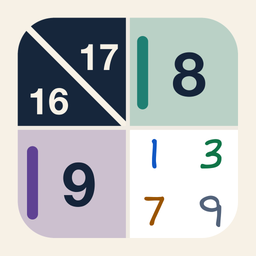
1. Forced combinations: the keys that turn first
Some clues can be made only one way. Two cells summing to 17 must be 8 and 9; there is no other pair of distinct digits that works. These forced clues are the best place to start a solve, when the grid offers them.
The ones worth knowing by heart:
| Run length | Low clues | High clues |
|---|---|---|
| 2 cells | 3 = 1+2, 4 = 1+3 | 16 = 7+9, 17 = 8+9 |
| 3 cells | 6 = 1+2+3, 7 = 1+2+4 | 23 = 6+8+9, 24 = 7+8+9 |
| 4 cells | 10 = 1+2+3+4, 11 = 1+2+3+5 | 29 = 5+7+8+9, 30 = 6+7+8+9 |
| 5 cells | 15, 16 | 34, 35 |
The pattern: for runs of 2 to 7 cells, the lowest two and highest two clues are forced. The long runs are better still: in an 8-cell run every clue is forced, because eight distinct digits leave exactly one of the nine out, and a 9-cell run is always the full 1 through 9. The complete list is in the combinations chart.
2. Crossing runs: where certainty comes from
A forced clue tells you which digits a run uses, not where they go. Position comes from the crossings. Every white cell belongs to two runs, and its digit must appear in both runs' possibilities.
The classic example: a two-cell 17 crossing a two-cell 16. The 17 uses only 8 and 9; the 16 uses only 7 and 9. Their shared cell must hold a digit from both sets, and only 9 qualifies. That one deduction then settles the 8 and the 7 in their partner cells.
17 across is {8, 9} and 16 down is {7, 9}. The crossing can only be the 9.
This is the engine of kakuro. Whenever you pencil in a run's combination, immediately walk its cells and ask what each crossing run allows. Most eliminations come from this intersection, not from new arithmetic.
3. High and low limits: pruning without a chart
When a clue has many combinations, its extremes still carry information. Two quick bounds prune candidates fast:
- A small clue caps its digits. In a two-cell 6, no cell can hold 6 or more, because its partner would need 0. And no cell can hold 3, because its partner would have to be another 3. That leaves 1, 2, 4, and 5 before you look at any crossing.
- A large clue floors its digits. In a two-cell 15, no cell can hold 5 or less, because its partner would need 10 or more. Only 6, 7, 8, and 9 are in play, and indeed the two combinations are 6+9 and 7+8.
Extreme is always relative to the run's length: 24 is the very top for three cells and unremarkable for five. So the instinct to build is to compare each clue against its own length's range, and the clues near either end of that range are the most informative ones on the board. When you want exactness rather than instinct, the chart's combinations column is the complete candidate list for a clue, and its "always uses" column marks the digits that are certain even when several combinations survive.
4. The 45 rule: the long-run shortcut
The digits 1 through 9 sum to 45. So a run of all nine digits always sums to 45, and more usefully, a run of eight cells is the full set minus one digit:
In an 8-cell run, the missing digit is 45 minus the clue. An 8-cell 41 is missing the 4, so the run holds every digit except 4. One subtraction turns the longest run on the board into one of the most constrained.
Experienced solvers extend the same idea to regions: pick a group of runs, and compare the sum of their clues against the sum of the clues crossing them. Cells covered by both sides cancel out, so the subtraction weighs the leftover cells of one side against the leftover cells of the other. The useful cases are the lopsided ones. When every leftover cell is on the same side, the difference is their combined value, and when that side's leftover is a single cell, you have its exact digit, which is the famous trick. With leftovers on both sides you learn only the difference between the two groups, which is occasionally still a clue and usually a sign to redraw the region. Spotting the right regions takes practice, but the arithmetic is never worse than adding a few clues and subtracting.
5. Pencilmark discipline: make deductions visible
None of the techniques above help if their results evaporate. Pencilmarks are how a deduction is kept:
- Write candidates only when a clue narrows them to two or three digits. Marking all nine teaches you nothing and buries the signal.
- When a digit lands anywhere in a run, strike it from every other cell of that run immediately. Stale marks cause more wrong entries than bad arithmetic does.
- Use position or color to mean something. Many solvers keep one color for "digits this cell could be" and another for "digits this combination would require", so the two kinds of maybe never blur.
Then trust the loop: tightest clue, pencil the combination, check every crossing, place what is certain, and repeat. When you stall, work back through the techniques in order. Often some run's surviving combinations share a digit you have not exploited yet, and the chart will show it; when they do not, the missing move is usually a crossing you have not re-checked since a digit landed, or a region where the 45 rule has something to say.
Practice the patterns
Kakuro Haven shows the combinations for the selected cell's runs right under the board and narrows the list as digits land. Color pencilmarks, strikeouts that stay struck, and hints that explain the next forced deduction when there is one, or point at the most constrained spot to investigate when there is not. Either way, no hint ever writes a digit for you. All 2,000+ puzzles free. No ads while you solve.